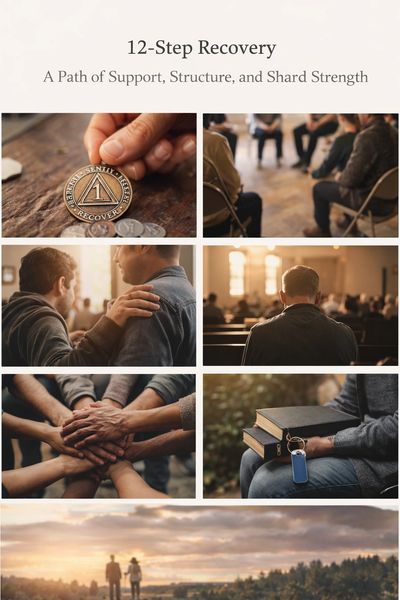
12-Step and Spiritual Recovery
Structured, community-based paths have helped millions of people rebuild their lives through shared experience, accountability, and spiritual reflection. No matter which path you choose, the beginning is difficult. That’s normal. Change is uncomfortable. Looking honestly at yourself is uncomfortable. Letting go of old ways of coping is uncomfortable. But it does get easier with time, and it begins the moment you decide you want something different.
The fact that you’re here means you already have.
You’ve already said, “I can’t keep doing this the same way.”
You’ve already said, “I want better.”
That takes courage. That takes humility. That takes strength.
So give yourself credit for that.
The 12-step path is built on the understanding that most people cannot do this alone. Not because they are weak, but because addiction thrives in isolation. It grows in silence. It survives in secrecy. Recovery, on the other hand, grows in connection.
It grows when you sit in a room with people who understand.
It grows when you hear your own story in someone else’s voice.
It grows when you realize you are not broken — you are human.
The good news is that change can happen in a moment.
But it also happens in moments.
Cravings will come. Doubt will come. Old thoughts will come back and tell you that “one more time” won’t matter. Setbacks may happen. That’s part of being human. That’s part of learning.
What matters is how you prepare.
If this goal truly matters to you, plan now for the hard days.
Who can you call when your mind starts lying to you?
Which meeting can you go to when you feel shaky?
Who knows your story and will answer without judgment?
Make that plan in advance.
Replace panic with connection.
Replace isolation with support.
Replace “I’ll deal with this later” with “I’ll reach out now.”
Know your exits.
Know your people.
Know your lifelines.
Then think about what helps you feel grounded and steady.
What makes you feel calm in your body?
What helps you feel present in your life?
What reminds you that you are more than this struggle?
For some people, it’s prayer.
For some, it’s walking.
For some, it’s journaling.
For some, it’s sitting quietly in a meeting and listening.
There is no “right” way to heal.
There is only the way that works for you.
Save those things for the days you need them most.
They become part of your armour.
Over time, difficult days lose their power.
Not because life becomes perfect.
Not because temptation disappears.
But because you’ve practiced responding differently.
You’ve leaned on others.
You’ve told the truth.
You’ve stayed when it was uncomfortable.
And it works.
Awareness matters here too.
The steps invite you to look honestly at yourself — not to shame you, but to free you.
To ask:
Is this a habit?
A wound?
A way to numb pain?
A way to avoid something that still needs care?
Understanding your patterns gives you power.
It gives you choices.
And with choices, change becomes possible.
Healing becomes possible.
Then comes your “why.” Why do you want sobriety? Peace? Health? Trust? Your family? Your future? Your self-respect? Your life back?
Write it down.
Keep it close.
On the hardest days, it will carry you.
Think about future you. Tomorrow you. Six-months-from-now you. Five-years-from-now you. How would they feel about today? What would they thank you for choosing? Because this is the moment where you get to choose differently.
You get to go to a meeting instead of disappearing.
You get to call your sponsor instead of isolating.
You get to sit with discomfort instead of escaping it.
You get to ask for help instead of pretending you’re fine.
You choose something different than last time.
There will be moments when it feels easier to give up than to keep going.
That doesn’t mean you’re failing.
That means you’re growing.
Those are the moments where recovery is built.
Each time you stay,
Each time you tell the truth,
Each time you reach out,
You reclaim a piece of your life.
This is your path.
Your work.
Your courage.
You may someday feel confident in your recovery.
Or you may never feel “strong,” yet still stay sober.
Both are valid.
What matters is that you keep showing up.
That you keep choosing life.
That you keep protecting your future.
You don’t have to do this alone.
And you were never meant to.
Community matters.
Support matters.
Honesty matters.
Connection matters.
Asking for help is not weakness.
It is wisdom.
It is resilience.
It is survival.
You are capable.
You are worthy.
You are learning how to live differently.
You are allowed compassion when you stumble.
Progress is built one decision at a time.
One meeting at a time.
One honest moment at a time.
Until those moments become a life you’re proud of.
And one day, when you’re steady,
when you’ve found your footing,
when you’ve rebuilt something real,
You’ll look at someone who is just starting…
And you’ll know exactly how to sit beside them.